How Reaction Time Training Can Improve Your Athletic Performance
The gap between a gold medal and fourth place is sometimes measured in milliseconds. A sprinter who leaves the blocks a fraction late, a goalkeeper who reads the flight of the ball just slightly too slow, a basketball player who hesitates for half a beat before releasing a pass. These moments feel like pure instinct. They are not. Reaction time is a trainable quality, and athletes who commit to developing it gain an edge that does not show up in weight room stats or aerobic fitness scores. It shows up in competition, at the moments that count most.
The Edge in a Millisecond
Reaction time is the delay between a stimulus and your body’s response. In sport, it separates those who adapt from those who get caught flat-footed. Training it means working the entire chain from perception through decision to movement. Athletes who measure their baseline first, then follow a structured progression of perceptual drills, can measurably cut their response times, often within just a few weeks of consistent practice.
What Happens Inside Your Brain the Instant You React
Before you can train reaction time, it helps to understand what you are actually training. A stimulus arrives, whether it is a starting gun, a moving ball, or a defender’s shift in weight. Your sensory organs detect it and send a signal through afferent nerve fibers to the brain. The brain processes the signal, selects an appropriate motor response, and fires efferent signals back down to the muscles. The whole loop takes time. That time is your reaction latency.
The prefrontal cortex handles decision-making, while the cerebellum and motor cortex coordinate the physical output. When choices are involved, such as deciding which direction to step or whether to shoot or pass, the processing load increases significantly. That is why choice-based reaction is slower than simple reaction. A sprinter responding to a single gunshot has one option. A soccer player deciding whether to cross or dribble has several. The brain must evaluate and commit, and that evaluation costs precious milliseconds.
The encouraging part is that neural pathways become more efficient with repetition. Studies into how the brain measures response speed confirm that repeated stimulus-response pairings reduce processing time as the brain builds stronger, faster connections. Consistent training is essentially teaching your nervous system to pick the right answer faster, not guess more aggressively.
Reaction Time Across Different Sports
Different sports stress reaction time in different ways. A sprinter needs simple reaction to a single auditory cue. A tennis player needs visual tracking combined with anticipation. A basketball defender needs to read multiple opponents simultaneously while managing their own fatigue. The common thread is that all of these athletes must process incoming information and produce a physical output with as little delay as possible.
Here are some of the key contexts where reaction speed directly shapes outcomes:
- Track sprinting: Getting off the blocks cleanly after the start signal can decide a 100m race before the athletes have taken three strides.
- Goalkeeping in soccer, hockey, and handball: Shot speeds routinely exceed what conscious deliberation can handle. Keepers rely on pattern recognition built through repetitive exposure.
- Racket sports: Tennis, badminton, and table tennis all require tracking a fast-moving object and recalculating its trajectory multiple times per second.
- Combat sports: Boxers, wrestlers, and martial artists read their opponent’s micro-movements and respond before the full technique is telegraphed.
- Team field sports: Football, basketball, and rugby constantly present multi-choice scenarios where athletes must react to teammates, opponents, and the ball at the same time.
Reaction time matters across all of them, but the type of training that will help most depends on which kind of stimulus your sport actually demands.
Measuring Your Baseline Before You Begin a Training Block
Jumping into reaction drills without knowing where you start is like training for a race without timing your runs. Your baseline tells you what the drills are changing, and whether those changes are meaningful. Without it, improvement becomes guesswork.
Simple reaction tests are easy to run. A screen flashes a signal and you click a button as fast as possible. These give you a raw number. But they miss a key dimension. Athletes in most sports do not respond to a single predictable stimulus. They respond to one of several stimuli, often under cognitive load and partial fatigue. That is where a choice reaction time test becomes far more useful as a self-assessment tool. It mimics the multi-option reality of competitive sport, presenting different stimuli that each demand a different response. Your score reflects not just how fast your muscles fire, but how quickly your brain can resolve ambiguity and commit to an action.
Run this assessment fresh, across multiple days, to get a stable average baseline. Then retest every two to three weeks during your training block. The numbers will tell you whether your nervous system is actually adapting or whether you need to adjust the training stimulus.
Progressive Drills That Challenge Your Response Speed
Good reaction training moves in stages. You start with simple drills that isolate one element of the stimulus-response chain, then layer in complexity as your nervous system adapts. This is not random chaos. It is structured challenge with a specific physiological goal.
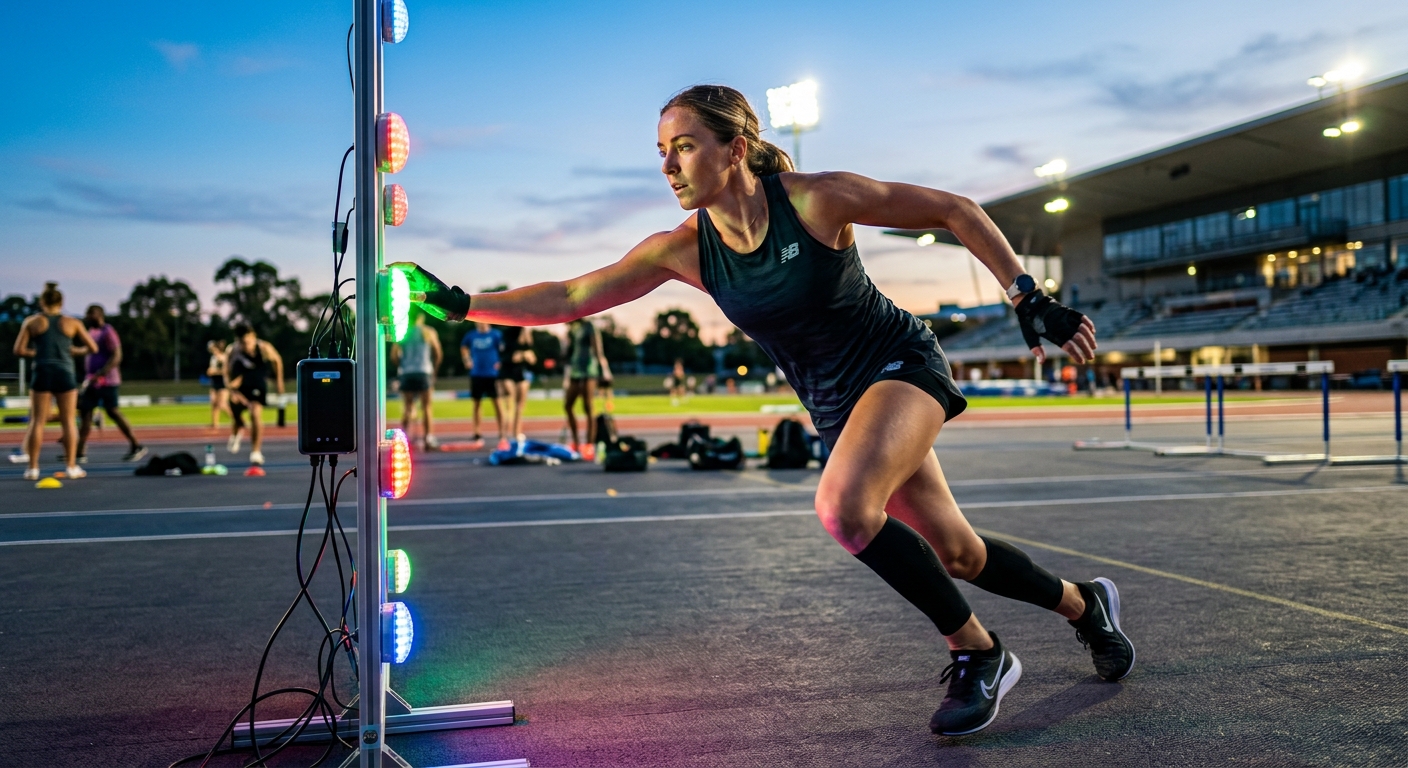
Begin with simple visual and auditory reaction drills. A partner drops a ruler and you catch it before it falls beyond a set distance. A light board flashes and you tap the lit panel. These drills develop the raw speed of your neural response. They also build the habit of sustained alertness, which is half the competitive battle.
From there, move into choice-based drills. Your training partner holds up colored paddles and you move in a direction tied to each color. A light board presents multiple options and you respond to only a specific one while ignoring the others. The cognitive load increases, and your brain learns to cut through that load faster with each session.
The most advanced stage is reactive decision-making under physical fatigue. Your body is depleted. Your processing speed drops. The best athletes train in this state deliberately because it forces the brain to maintain clarity when conditions are hostile. A typical drill might involve a sprint interval followed immediately by a choice-based reaction task, mimicking what the final minutes of a match actually feel like.
Why Fatigue Is the Hardest Condition to Train For
A rested athlete performing at peak is not the scenario that defines championships. What matters is the athlete in the 80th minute of a match, the final round of a fight, or the last leg of a relay. At those points, the nervous system is under pressure, neural glucose is depleted, and motor control is degraded. Reaction time can increase by 30 percent or more under significant physical fatigue.
Training in a fatigued state is not about pushing through with poor technique. It is about exposing the nervous system to those conditions in a controlled setting. Over time, the brain gets better at maintaining processing speed even when energy resources are thin. Athletes who train this way consistently report that the late stages of competition feel more mentally organized, not physically easier, but clearer. That clarity is the adaptation you are chasing.
The Anticipation Layer That Multiplies Your Reactive Advantage
Pure reaction speed is only one piece of the puzzle. The other piece is anticipation, the ability to read cues before the decisive action actually happens. Elite athletes do not only respond faster. They start earlier because they identify what is coming from partial information before the movement is complete.
A goalkeeper reads a striker’s plant foot before the shot. A tennis player reads shoulder rotation before the racket swings. A basketball defender reads hip alignment before a crossover. These athletes are compressing their effective reaction time without their muscles doing anything faster. They are simply giving their nervous system a head start through pattern recognition built over thousands of repetitions.
This anticipatory processing is trained through video analysis, pattern repetition, and deliberate attention to opponent body language in practice. Combining it with direct reaction training creates an athlete who is both fast to respond and early to recognize. That combination is what separates competitive athletes from exceptional ones at the highest levels of sport.
Fitting Reaction Work Into Your Training Week
Reaction training does not need its own dedicated day. It integrates cleanly into existing sessions when placed thoughtfully within the structure of your week. Consider organizing it around your energy levels and the fatigue demands of each session:
- At the start of a session when the central nervous system is fresh: Use simple reaction drills as activation work, keeping sets short and intensity high to prime the nervous system for the rest of training.
- Mid-session after moderate fatigue has set in: Shift to choice-based drills that require active decision-making, adding realistic cognitive load without destroying movement quality.
- Late session or at the end of a conditioning block: Reserve fatigued-state reaction tasks for the final phase, when physical depletion mirrors what competition actually demands in its final stages.
Two to three targeted reaction sessions per week is enough for meaningful adaptation. More is not better. The nervous system needs recovery time to consolidate gains. Overloading it leads to slower processing, increased error rates, and higher injury risk from poor movement decisions under duress.
When Sharper Reactions Start Changing the Outcome of Competition
Most athletes notice changes within three to four weeks of consistent reaction training. The changes are subtle at first. A pass intercepted that would have gone through last month. A defensive adjustment completed in time. A starting position that felt clean rather than rushed. These are not random improvements. They are the signature of a nervous system that has been challenged to adapt and has done exactly that.
The longer-term gains tend to be more striking. Athletes who commit to reaction training across a full season often report that the game appears to “slow down” for them. This is a well-documented perceptual effect tied to processing efficiency. When your brain handles incoming information more fluidly, time feels less compressed. You feel less rushed. Decisions arrive with more clarity. The sport becomes more readable at speed.
That sense of clarity is not mystical. It is the product of a nervous system that has been trained to process, decide, and act with less delay. Any athlete willing to approach reaction training with the same discipline they bring to strength or conditioning work can access those gains. The milliseconds are there to be earned.