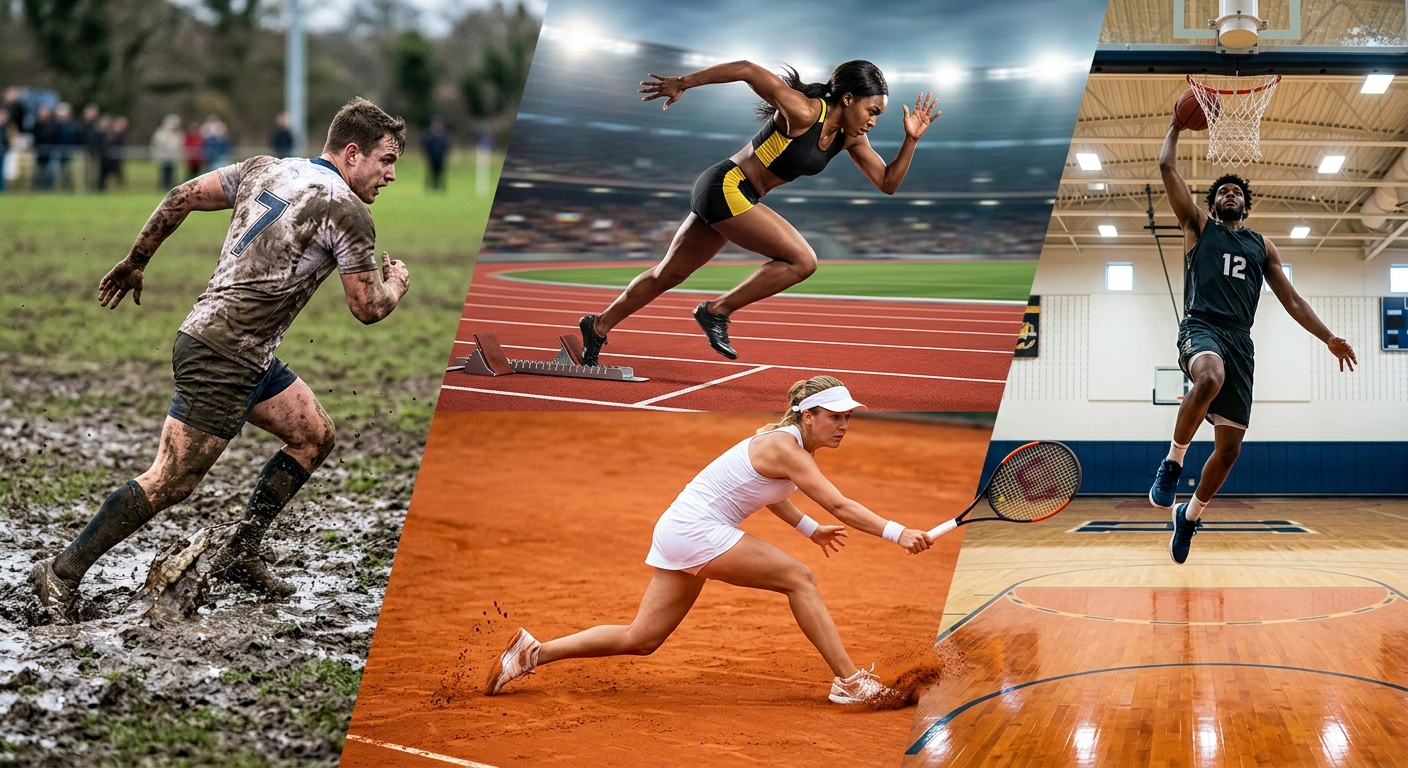
How Ground Conditions Shape Athletic Performance Across Sports
The ground beneath an athlete’s feet is doing far more work than most people realize. It absorbs force. It returns energy. It shifts the entire mechanical conversation between a body and gravity. Change the surface, and you change the sport, even when every other variable stays exactly the same. Athletes who ignore this truth often pay for it in slower times, in fatigue that arrives too early, or in injuries that could have been prevented.
Surface Science at a Glance
- Surface hardness directly influences how much impact energy travels into joints and muscles on each stride or plant.
- Moisture content alters traction, foot strike angles, and the metabolic cost of movement across all sports and disciplines.
- Standardized condition frameworks, including those used in horse racing, offer a proven model for translating ground quality into actionable performance data.
Why the Ground Is an Invisible Training Variable
Most training plans account for volume, intensity, rest, and nutrition. Very few formally account for the surface. Yet the surface is always there, silently shaping every rep, every sprint, every stride. The mechanics of how a body moves change significantly depending on what it is pushing against.
On a hard surface, the ground returns energy quickly. A runner’s foot strikes and bounces back with minimal deformation of the surface itself. This is efficient in short bursts but punishing over distance. The muscles and tendons absorb the difference, which means more eccentric loading and a higher risk of stress injuries over time. On a softer surface, the ground deforms and absorbs more of the energy. That reduces peak impact forces but demands more muscular work to stabilize the foot and ankle on each step.
This is not a minor distinction. Research published through the British Journal of Sports Medicine has consistently linked surface hardness with stress fracture rates in endurance athletes, particularly in runners transitioning between training environments. The body adapts to the surface it trains on. A sudden shift disrupts that adaptation and raises injury risk sharply.
Moisture’s Overlooked Role in Movement Quality
Water changes everything. A dry grass field and a rain-soaked grass field are not the same surface, even though they look like they should be. Moisture alters the coefficient of friction between a shoe and the ground. It changes how much the surface gives under load. It affects how a foot plant translates into forward propulsion.
In team sports, this matters immediately and visibly. A wet pitch makes sudden direction changes more dangerous because the friction needed to decelerate and redirect is simply not there. Players who have trained their cutting mechanics on dry turf must unconsciously recalibrate on a damp one. Those who fail to recalibrate face elevated risk of knee and ankle ligament injuries.
Moisture also affects the energy cost of running. Soft, wet ground requires more muscular effort to push off, which can increase oxygen consumption by several percentage points over a match or race. That extra demand accumulates. In the final twenty minutes of a game, fatigue-related errors and injuries tend to cluster, and surface conditions are often a contributing factor that goes unacknowledged in post-match analysis.
Terrain Variation and the Energy Demands It Creates
Flat surfaces are a relatively modern invention in athletic contexts. Cross-country runners, trail athletes, and field sport players all deal with terrain that changes underfoot constantly. Inclines, declines, cambers, uneven patches, and transitions between firm and soft sections all require the body to make rapid neuromuscular adjustments.
These adjustments carry a measurable metabolic cost. Studies comparing treadmill running at matched speeds with outdoor running on varied terrain consistently find that outdoor running demands more energy, even when elevation gain is controlled. The brain and nervous system are doing extra work, constantly reading the surface ahead and preparing the body for what is coming next. That cognitive-motor load is real, and it contributes to fatigue in ways that flat-surface training does not replicate.
For coaches building periodization plans, this has a direct implication. Training exclusively on consistent surfaces leaves an athlete underprepared for competition environments that involve terrain variation. Strategically including varied-surface sessions builds the neuromuscular adaptability that race-day performance actually demands.
How Horse Racing Turned Ground Assessment into a Science
Most sports rely on informal descriptions of surface conditions. Horse racing took a different path. It developed a formal classification system that now underpins how races are analyzed and how performance expectations are set. The concept of the going, which describes the state of the turf based on moisture content and firmness, gives trainers, jockeys, and analysts a shared language for ground conditions.
Understanding what is the going in horse racing means understanding how a standardized scale, ranging from firm ground through good, soft, and heavy, reflects the biomechanical reality of how a horse’s hoof interacts with the turf. Horses that perform best on firm ground often struggle on heavy going because the mechanical demands shift completely. The limb loading patterns change. The stride length shortens. The energy required to move forward increases substantially on softer ground, and the risk of soft tissue injury rises on firmer going where impact forces peak much higher.
This classification system is arguably the most formalized example in any sport of ground conditions being treated as a quantifiable performance variable rather than background noise. That formalization exists because the stakes in horse racing are high enough that getting it wrong is immediately costly. The lesson for other sports is clear: when you measure something precisely, you can act on it intelligently.
Surface Types Compared by Performance Impact
| Surface Type | Impact Absorption | Traction Level | Energy Cost to Athlete | Primary Injury Risk |
|---|---|---|---|---|
| Hard Court / Concrete | Very Low | High | Low (high energy return) | Stress fractures, shin splints |
| Firm Natural Turf | Low to Moderate | High | Low | ACL stress, ankle sprains |
| Wet / Soft Grass | High | Low | Higher (poor energy return) | Ligament tears, slipping injuries |
| Artificial Turf | Moderate | Very High | Moderate | ACL injuries, turf burns |
| Trail / Mixed Terrain | Variable | Variable | High (heavy neuromuscular load) | Ankle rolls, IT band stress |
| Heavy / Waterlogged Turf | Very High | Very Low | Very High | Soft tissue tears, falls |
Artificial Turf and the Debate That Refuses to Settle
Few topics generate more disagreement in team sports than artificial turf. On one side, it offers consistency. It drains well, does not vary with the weather, and holds up through heavy use. On the other side, the biomechanics tell a more complicated story.
Artificial turf typically returns energy differently from natural grass. The higher traction coefficient means that a cleated shoe grips and releases in ways that put different torque patterns through the knee and ankle. Some research suggests artificial surfaces are associated with higher rates of ACL injury, particularly in sports involving rapid changes of direction. Other studies find that when turf quality is carefully maintained, the performance and injury gap narrows considerably. The debate turns heavily on what counts as a quality surface and how consistently that quality is actually preserved across a full playing season.
What is clear is that athletes and coaches cannot assume all surfaces within a single category are equivalent. An artificial pitch installed five years ago and one installed five weeks ago are not the same surface. The infill compacts. The pile height changes. The mechanical properties shift, and an athlete’s body has to deal with whatever the surface actually is on match day, not what it was rated as when it was new.
Building Surface Awareness into Team Sport Preparation
Coaches in professional team sports increasingly analyze upcoming fixture surfaces as part of match preparation. A structured approach to surface scouting typically unfolds in the following order:
- Identify the expected surface type and, where possible, the specific pitch’s recent condition history, including rainfall in the preceding days, drainage quality, and maintenance schedule.
- Adjust the training week to include sessions on a comparable surface, or at minimum, flag the surface change as a variable to monitor closely during the pre-match warmup.
- Brief players on the expected traction conditions so they can consciously calibrate their cutting mechanics, sprint starts, and braking patterns before the game begins.
- Monitor load metrics during the match with particular attention to soft tissue fatigue indicators, which tend to spike when athletes work on surfaces demanding more muscular stabilization than usual.
- Shape post-match recovery protocols according to the surface played on, since harder surfaces generate higher systemic impact loads even at the same running volume.
Running Performance and the Ground Reaction Force Equation
In competitive running, the interaction between the foot and the surface is the engine of propulsion. Ground reaction force, the force the ground exerts back on the foot, is what drives a runner forward. The characteristics of the surface determine how that force behaves.
On a very hard surface, ground reaction force peaks sharply and briefly. On a soft surface, the force is lower in peak magnitude but extended in duration. Elite runners and their coaches track these patterns carefully because they affect cadence, stride length, and the distribution of loading across the body. A runner optimized for road racing may find that a cross-country course with variable softness disrupts their natural stride mechanics in ways that cost time and accumulate fatigue.
Footwear selection is one tool for managing this relationship. Shoe stiffness, stack height, and midsole material all interact with surface properties to shape the final ground reaction force experienced by the body. But footwear is only part of the answer. The athlete’s movement patterns, and how adaptable those patterns are to changing surfaces, matter at least as much as what is on their feet.
Translating Surface Knowledge into Race-Day Decisions
The gap between knowing that surfaces matter and actually accounting for them in training decisions is where most athletes and coaches still have room to grow. Surface literacy does not require expensive equipment or complex testing. It starts with observation and builds toward habit.
A coach who logs the surface conditions of every training session alongside intensity and volume data will, over time, accumulate genuinely useful information. Patterns will appear. An athlete who consistently performs well on firm surfaces but fades on soft ground is showing the coach something important about their biomechanics and conditioning. That information can shape targeted interventions during the off-season before it becomes a race-day problem.
Race-day preparation should treat surface conditions as a variable to be scouted, not just accepted. In horse racing, this is standard practice, because the formal classification system creates a shared vocabulary that makes condition-based decisions possible at every level of the sport. Other sports are catching up, gradually building the tools and frameworks to treat the ground as the performance variable it has always been.
The athletes who perform most consistently across conditions are not those who simply run fast or jump high. They are those who have trained their bodies to read and respond to what is under their feet, adapting their mechanics fluidly and intelligently as conditions change. That adaptability, built through deliberate surface-varied training, is one of the quieter edges in high-level competition.
Where Every Performance Actually Begins
The surface is never neutral. It is always influencing the outcome, adding or subtracting from an athlete’s potential on any given day. The sports that have been most deliberate about measuring and classifying ground conditions have earned a genuine performance advantage, because they are making decisions based on reality rather than assumption.
The insights from running biomechanics, team sport injury data, and the formalized condition frameworks of equestrian sport all point in the same direction. Ground conditions are a performance variable with real, measurable effects on biomechanics, energy cost, and injury risk. Coaches and athletes who treat the surface as part of the equation, rather than just the thing that happens to be beneath them, are making smarter preparation decisions every single week.
Start paying attention to what is under your feet. The data has been there all along.