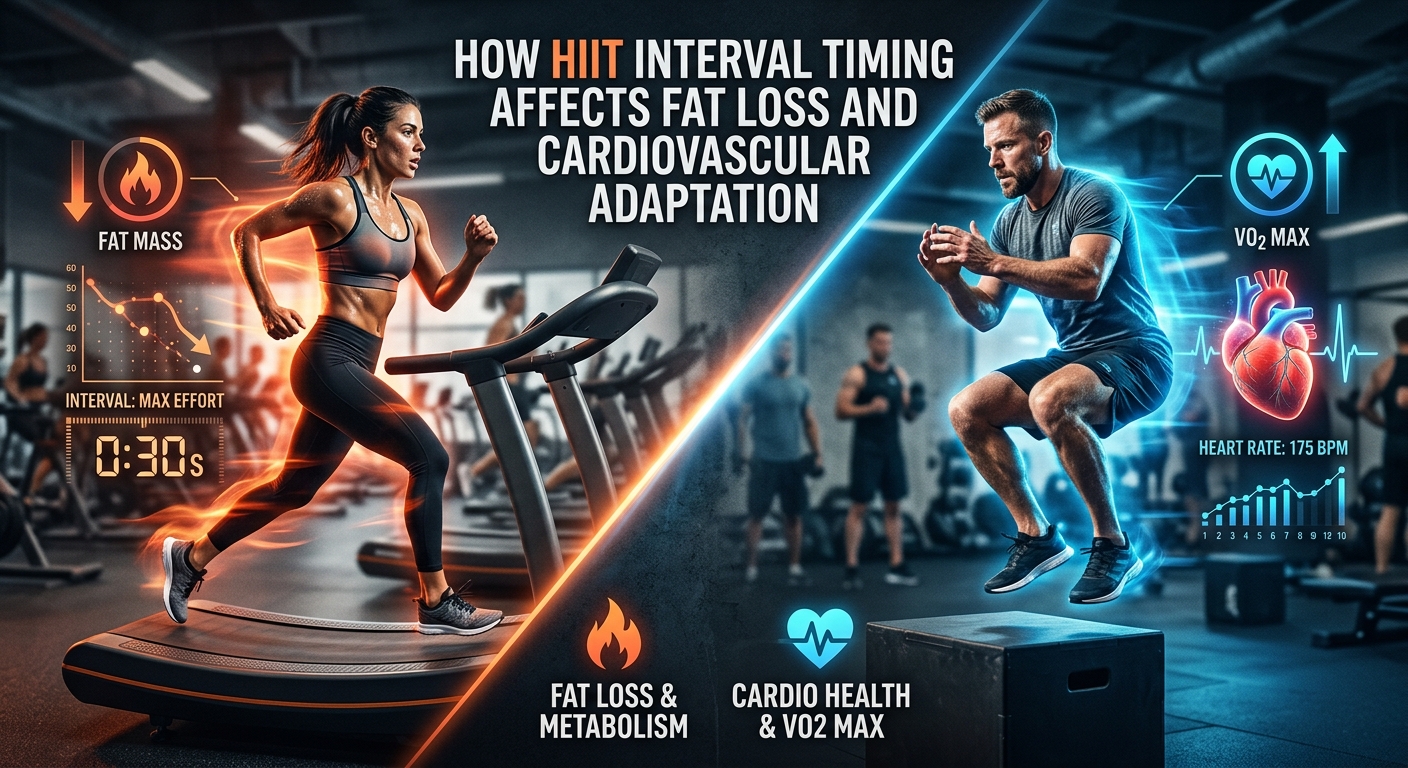
How HIIT Interval Timing Affects Fat Loss and Cardiovascular Adaptation
Thirty seconds can change everything. That is not a bold claim. It is basic exercise physiology. The exact amount of time you work and the exact amount of time you recover determines which energy systems fire, which hormones surge, and whether your heart gets stronger or just tired. Most people obsess over exercise selection. The real lever hiding in plain sight is the clock.
Training Intelligence: Key Timing Facts
- Work-to-rest ratio determines whether you train the aerobic system, the anaerobic system, or both at once.
- EPOC (excess post-exercise oxygen consumption) can keep fat burning elevated for up to 24 hours after a HIIT session.
- Longer work intervals of 3 to 5 minutes produce the greatest VO2 max gains of any interval structure.
- Shorter rest periods amplify catecholamine and growth hormone release, creating a powerful lipolytic environment.
- Even small drift in rest duration changes the training stimulus across a full session and compounds over weeks.
The Hidden Power of Work-to-Rest Ratios
Work-to-rest ratios are the structural foundation of every HIIT protocol. A 1:1 ratio means you rest as long as you worked. A 1:2 ratio gives you twice the recovery. A 2:1 ratio cuts rest to half your work period. These numbers are not arbitrary preferences. They target distinct physiological systems with genuine precision.
At a 2:1 ratio, like the classic Tabata protocol of 20 seconds on and 10 seconds off, glycolytic pathways dominate. Your body relies on fast-twitch muscle fibers and anaerobic metabolism. Recovery is deliberately incomplete. That sustained oxygen deficit forces powerful cardiovascular stress and drives metabolic adaptation.
At a 1:2 or 1:3 ratio, your phosphocreatine system has more time to replenish. Sprint power is higher each interval because you are fresher going in. The aerobic contribution per interval drops. You generate more speed but less cumulative metabolic stress across the session. Both approaches work. They just work toward different outcomes, and confusing the two produces confused results.
The ratio is not a stylistic choice. It is a programming decision with real physiological consequences that compound over every week of training.
EPOC: How Interval Timing Creates Hours of Fat Burning
Excess post-exercise oxygen consumption is the mechanism behind what many coaches call the afterburn effect. After intense interval training, your body stays in a metabolically elevated state while it works to restore internal balance. Oxygen debt gets repaid. Muscle glycogen is rebuilt. Core temperature comes back down. All of that restoration work burns calories, and it continues long after you leave the gym.
Short rest periods increase EPOC significantly. When rest is incomplete, your body cannot fully clear lactate or restore phosphocreatine before the next interval begins. The accumulated oxygen deficit grows larger. The post-workout restoration process becomes longer and more metabolically expensive. That is exactly the outcome you want for fat loss.
Work interval duration also matters. Intervals lasting 20 to 30 seconds at near-maximal effort create a strong anaerobic demand. Intervals lasting 60 seconds or longer at high intensity build a large aerobic demand while still generating meaningful EPOC. Both structures are valid fat-loss tools. The key is keeping rest periods precise so you replicate the intended physiological demand across every interval of every session.
That is where accurate timing becomes non-negotiable. Using a dedicated HIIT timer ensures your rest periods do not drift from 30 seconds to 45 seconds between rounds without you noticing. Even small drift in rest duration changes the training stimulus over a full session and compounds across weeks of programming into a very different adaptation than the one you intended.
VO2 Max Gains Depend on How Long You Push
VO2 max is your body’s maximum capacity to consume and use oxygen during exercise. It is one of the strongest predictors of both cardiovascular health and athletic performance across virtually every sport. Interval training is the most efficient way to raise it, but the length of your work intervals determines how much of that ceiling you actually shift.
Research consistently shows that intervals lasting between three and five minutes at 90 to 95 percent of VO2 max produce the largest improvements in aerobic capacity. That duration keeps you operating near your cardiovascular ceiling long enough to force real central adaptation. Your heart’s stroke volume increases. Cardiac output improves. Mitochondrial density in active muscle tissue rises substantially.
Ultra-short sprints under 15 seconds are valuable for power and neuromuscular development, but they do not sustain you at VO2 max long enough to drive the same degree of cardiovascular remodeling. The work interval must be long enough to push your heart to the edge of its capacity for a meaningful portion of each training session.
Key cardiovascular adaptations produced by properly structured interval training include:
- Increased left ventricular volume, allowing more blood output per heartbeat
- Lower resting heart rate through improved parasympathetic nervous system tone
- Greater capillary density within active muscle tissue
- Improved oxygen extraction efficiency at the cellular and mitochondrial level
- Faster heart rate recovery after bouts of intense effort
The Hormonal Clock: Why Rest Duration Changes Everything
Your endocrine system responds to training stress with remarkable specificity. The hormonal environment created during a HIIT session depends heavily on how long you rest between efforts. Structure this correctly and you accelerate fat loss, preserve lean tissue, and drive aerobic development at the same time.
Catecholamines, specifically epinephrine and norepinephrine, spike during intense intervals. They mobilize fatty acids from adipose tissue and drive fast-twitch muscle recruitment. Shorter rest periods keep catecholamine levels elevated throughout the session, creating a sustained fat-mobilizing environment that extends well into post-workout recovery.
Growth hormone release is also strongly tied to interval structure. Incomplete recovery between bouts amplifies the GH response. Cumulative lactate accumulation, which is greater with shorter rests, is a primary driver of exercise-induced growth hormone secretion. This matters for both fat metabolism and lean tissue preservation across a training cycle.
Short Rests vs Long Rests: The Hormonal Trade-Off
The rest period is not just downtime. It is an active hormonal modulator. Different rest durations produce meaningfully distinct biochemical environments throughout the session:
- Short rest (10 to 30 seconds): Sustains high catecholamine levels, greater lactate accumulation, stronger growth hormone pulse, and elevated cortisol. Effective in limited doses but demands careful volume management to avoid overreaching.
- Moderate rest (60 to 90 seconds): Allows partial phosphocreatine recovery while maintaining metabolic stress. Balances intensity with the volume capacity needed to complete a full session without quality breakdown.
- Long rest (2 to 3 minutes): Supports near-maximal power output on each interval. Best suited to VO2 max development and sprint-based work where per-interval quality matters more than metabolic density.
Cortisol deserves specific attention here. It rises with both training volume and intensity. Chronically short rest periods combined with high session volume can push cortisol into a range that becomes catabolic and impairs recovery between training days. Smart programming cycles across these protocols and monitors cumulative load over weeks rather than chasing maximum stress every session.
HIIT Protocol Comparison by Work-to-Rest Structure
Common Interval Structures and Their Physiological Focus
| Protocol | Work:Rest Ratio | Work Duration | Primary Adaptation | EPOC Level |
|---|---|---|---|---|
| Tabata | 2:1 | 20 seconds | Anaerobic capacity and VO2 max | Very high |
| Sprint Intervals | 1:3 | 10 to 15 seconds | Peak power and neuromuscular output | Moderate |
| Classic HIIT | 1:2 | 30 seconds | Metabolic conditioning and fat loss | High |
| Aerobic Intervals | 1:1 to 1:1.5 | 3 to 5 minutes | VO2 max and cardiac output | High with sustained aerobic demand |
Building an Interval Program That Targets Your Goal
Programming HIIT effectively is less about finding a trendy workout and more about matching your interval structure to a specific adaptation target. A systematic approach makes the difference between training that compounds and training that just tires you out.
- Define your primary adaptation target. Fat loss, VO2 max development, power output, and general cardiovascular health each favor different interval structures. Identify your priority before selecting any timing parameters.
- Choose your work duration based on that target. For VO2 max, use three to five minute work intervals. For metabolic conditioning and EPOC, use 20 to 60 seconds. For peak power development, keep work under 15 seconds with full recovery between efforts.
- Calculate rest from your intended ratio. For metabolic stress and fat loss, a 1:2 ratio is a strong baseline. For maximum power output each interval, extend rest to 1:3 or longer to allow phosphocreatine replenishment.
- Set total session volume based on your training level. Beginners should complete three to five intervals. Advanced athletes can handle eight to twelve depending on intensity. Volume and intensity carry an inverse relationship that must be respected.
- Track adaptation markers across weeks rather than just fatigue. Measure perceived effort at the same work output, resting heart rate, and post-interval heart rate recovery. These signal genuine adaptation versus accumulated tiredness.
- Revise the structure every four to six weeks. Your physiology adapts to the specific demand you place on it. Change the ratio, the work duration, or the target intensity periodically to continue generating a novel stimulus.
The Interval Equation That Drives Every Adaptation You Are After
Timing is not a background variable in interval training. It is the central variable. Every second of your work period and every second of your rest shapes what your body does during the session and what it becomes afterwards. Shifting the work-to-rest ratio by even 30 seconds does not just feel different. It changes the dominant energy system, the hormonal response, the degree of cardiovascular stress, and the depth of your EPOC window.
Aerobic capacity improvements follow a clear dose-response relationship with exercise intensity and duration. The World Health Organization’s guidance on physical activity intensity makes this principle explicit: the body adapts specifically to the demands placed on it, and those demands are defined precisely by the structure of each interval.
This is why serious coaches do not use approximate rest periods. A rest that was meant to be 60 seconds but stretches to 90 produces a fundamentally different next interval. Across a 10-week training cycle, that drift compounds into a different adaptation profile than the one you planned for. The athlete who trains with sloppy timing is not running the same program as the athlete who trains with precise timing, even if every other variable looks identical on paper.
Precision here is not perfectionism. It is the mechanism by which you control your physiological outcomes rather than just hoping the session was hard enough. Train with that understanding, and every session becomes a deliberate investment in a specific cardiovascular and metabolic result rather than a general effort with unpredictable returns.